Sales teams today aren’t struggling with a lack of leads—they’re struggling with knowing which leads actually matter. Between disconnected tools, manual qualification processes, and subjective scoring, most teams often end up prioritizing the wrong prospects, slowing down sales cycles. According to HubSpot, 28% of sales professionals cite lengthy sales processes as the primary reason good prospects back out of deals. Lead scoring automation tools simplify reps’ workflows and improve sales process efficiency.
![Download Now: Lead Scoring Calculator [Free Template]](https://no-cache.hubspot.com/cta/default/53/ee17df5d-dff8-412f-906d-f91308678766.png) What are lead scoring automation tools?
What are lead scoring automation tools?
What are lead scoring automation tools?
Lead scoring automation tools are software platforms that assign numerical values to leads based on predefined criteria, behavioral patterns, and predictive signals. They evaluate prospects automatically by analyzing attributes such as job title, company size, website engagement, email interactions, and content consumption patterns in real time, replacing manual qualification with continuous, real-time scoring as new data becomes available.
Lead scoring automation software falls into two categories:
- Traditional or rules-based systems that apply fixed scoring logic determined by sales and marketing teams
- Predictive models that use machine learning algorithms to identify patterns in historical conversion data
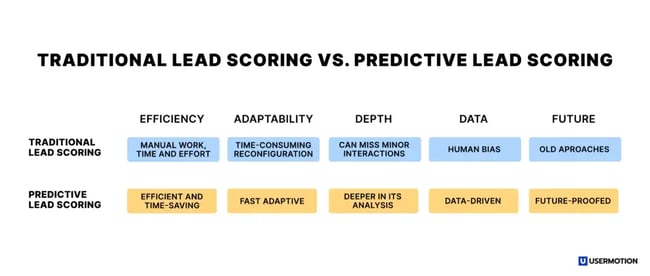
Both approaches aim to simplify effective lead management and help revenue teams prioritize outreach, allocate resources efficiently, and focus selling efforts on prospects most likely to convert.
How do lead scoring automation tools work?
Lead scoring automation tools function by ingesting data from multiple sources across the customer journey, applying scoring logic to each data point, and outputting a composite score that represents purchase intent or qualification level.
- The lead scoring automation process begins once a prospect enters the system through form submissions, website visits, email engagement, social media interactions, or third-party data integrations.
- The lead scoring engine then evaluates each interaction or attribute against established parameters:
- In traditional or rules-based systems, predetermined point values are assigned to specific actions or characteristics.
For example, sales and marketing teams could define a scoring system that assigns 10 points for downloading a pricing guide, 5 points for attending a webinar, or 20 points for visiting the pricing page 3 times in one week. Firmographic criteria may be treated similarly, with larger companies or specific industries receiving higher scores based on alignment with the ideal customer profile.
- In predictive lead scoring automation tools, the approach is slightly different. The lead scoring software analyzes thousands of historical leads to identify which attributes and behaviors correlate most strongly with closed deals.
The machine learning models detect patterns that human teams might miss, such as the significance of viewing specific product pages in a particular sequence or the predictive value of engaging with certain email subject lines. Further, the algorithm continuously refines itself as new conversion data becomes available.
- Whether through a rules-based system or predictive lead scoring, once lead scores are calculated, the automation platform typically triggers configured workflows based on threshold criteria.
For example, high-scoring leads may automatically route to sales representatives via lead distribution software, enter nurture sequences, or receive priority status in the CRM.
- Meanwhile, the system dynamically updates lead scores as prospects continue to interact across various touchpoints, ensuring sales teams always have up-to-date intelligence on which opportunities warrant immediate attention.
The workings of lead scoring solutions described above rely on the following key components:
- Data integration layers that connect CRM systems, marketing automation platforms, website analytics, email tools, and third-party data sources
- Scoring logic engines that apply rules-based formulas or machine learning algorithms to incoming data
- Threshold management systems that define when leads qualify for specific actions or handoffs
- Workflow automation capabilities that trigger follow-up actions based on score changes
- Reporting dashboards that track scoring performance, conversion rates by score range, and model accuracy over time
Features to Look for In Lead Scoring Automation Software
Evaluating and choosing from the wide range of B2B lead scoring automation tools requires looking beyond surface-level functionality. The best lead scoring automation platforms offer features such as customizable scoring criteria, real-time score updates based on behavioral signals, and unified data across marketing and CRM systems to prevent fragmented decision-making. In addition, lead scoring tools that connect lead scores directly to automation workflows and sales handoffs perform better in sales environments where speed, alignment, and consistency directly influence conversion rates.
1. Customizable Scoring Criteria
Accurate lead scoring should reflect the organization’s business model rather than generic assumptions. The best B2B lead scoring automation tools enable teams to assign scores based on specific demographic and firmographic attributes (such as job title, company size, or industry) as well as behavioral signals (like form fills, page views, or email clicks). This flexibility ensures that lead scores align with one’s ideal customer profile and buying journey, not with generic best practices.
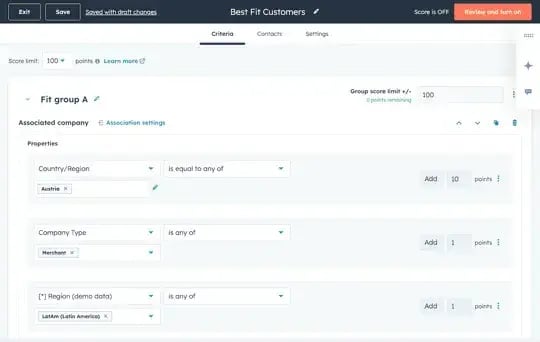
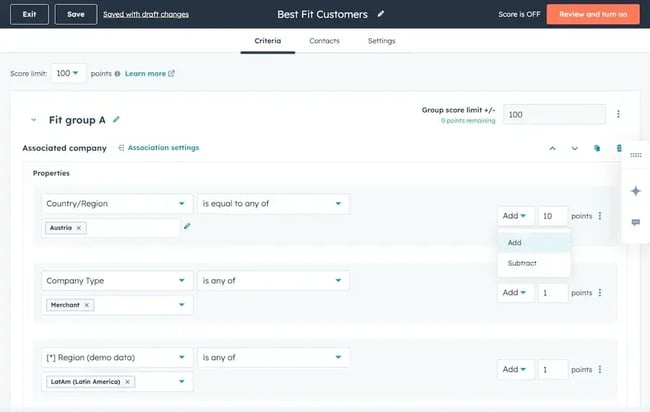
For instance, HubSpot allows users to build fully customizable lead scoring models using both explicit data (contact and company properties) and implicit data (marketing and website behavior). Using it, teams can:
- Define positive and negative scores.
- Create multiple scoring models.
- Adjust criteria as their go-to-market strategy evolves.
That makes HubSpot’s Lead Scoring software practical for both SMBs and scaling teams.
2. Real-time Score Updates Based on Behavior
Lead scoring loses value if it doesn’t update as soon as a prospect takes action. The best lead scoring tools automatically recalculate scores when leads engage with key touchpoints, enabling sales teams to respond at the right moment rather than going by outdated qualification signals.
HubSpot’s Lead Scoring Software updates lead scores dynamically as contacts interact with emails, landing pages, forms, ads, and website content, ensuring sales teams always see the most up-to-date qualification status in the CRM.
3. Unified Data Across Marketing and CRM
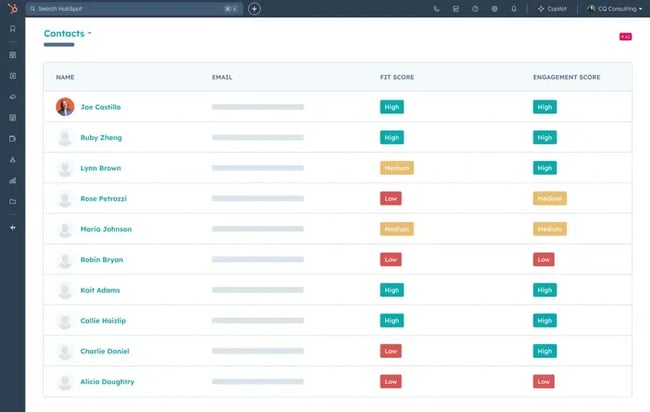
Fragmented data hampers accurate lead scoring. Lead scoring software that natively connects marketing activity to CRM records is important to ensure lead scores reflect a complete view of the buyer’s interactions, rather than relying on siloed systems or partial data.
HubSpot’s Lead Scoring Software unifies CRM and Marketing data, eliminating the need for complex data stitching. That ensures marketing techniques and sales work in alignment.
4. Scalable Logic That Supports Automation and Growth
As teams grow, it’s important that their lead scoring mechanism scales with them. Best-in-class lead scoring software includes features to support automated workflows, segmentation, and handoffs to sales, without requiring constant manual intervention or advanced technical setup.
HubSpot’s Lead Scoring Software unifies lead scoring with workflows, lists, and lifecycle automation, enabling teams to scale and grow easily. In HubSpot, once a lead reaches a defined score threshold, teams using the HubSpot ecosystem can automatically trigger next steps, such as sending sales notifications, assigning owners, or moving contacts to the next stage.
Best Lead Scoring Automation Tools
Choosing the right lead scoring automation tool can be the differentiating factor between sales teams chasing cold leads and closing high-intent buyers at the right moment. Here are five lead scoring tools that stand out:
1. HubSpot Lead Scoring Software
G2 rating: 4.4/5
Best for: Mid-market and enterprise companies seeking unified sales and marketing platforms with sophisticated scoring capabilities
HubSpot’s Lead Scoring software offers enterprise-grade lead scoring capabilities within a unified CRM platform that combines marketing automation, sales engagement, customer service, and operations tools.
With a robust integration ecosystem, the lead scoring software ingests behavioral data from various channels beyond HubSpot’s native tools. With that, it offers both manual scoring for organizations that prefer rules-based approaches and predictive lead scoring powered by machine-learning algorithms that automatically analyze conversion patterns. The workflow engine supports complex logic, including score-decay rules that penalize inactive prospects’ scores. Score decay ensures sales teams focus on currently engaged opportunities rather than historically qualified leads that have gone cold.
Core Features
- Supports rules-based and predictive lead scoring models: HubSpot supports both customizable scoring rules and predictive scoring (in higher plans), giving teams access to both tailored scoring logic and AI-powered insights.
- Native CRM integration: Lead scores live inside HubSpot Smart CRM, unifying marketing and sales data for seamless prioritization and follow-up.
- Real-time score updates: Lead scores adjust automatically as contacts interact across touchpoints such as emails, website content, forms, or campaigns, ensuring up-to-date scores.
- Workflow automation: HubSpot enables triggering sales notifications, creating tasks, and starting nurture sequences once leads reach a defined score threshold.
- Score decay logic: Prevents outdated engagement from inflating lead priority.
Free trial: Yes
Pricing: Lead scoring is available in premium editions of Marketing Hub. Standard contact scoring is available in premium editions of all Hubs (see pricing page for more information).
Marketing Hub’s Professional Plan costs $800/month for 3 users, and the Enterprise Plan costs $3,600/month for 5 users. Teams that only need manual scoring features can start with the Starter Plan, which costs $9/month per seat for 1,000 marketing contacts.
What we like: HubSpot’s standout strengths are its seamless integration and ease of use. In HubSpot, lead scoring isn’t an isolated feature; it’s part of the customer lifecycle. The balance between rules-based and predictive scoring also makes it easier for teams to start with a simple approach and refine it over time. One limitation to note is that the price point may be restrictive for smaller companies.
2. Salesmate Lead Scoring Software
G2 rating: 4.7/5
Best for: Growing teams looking to start with an affordable CRM that includes basic lead scoring, integrated sales activity tracking, and multi-channel engagement.
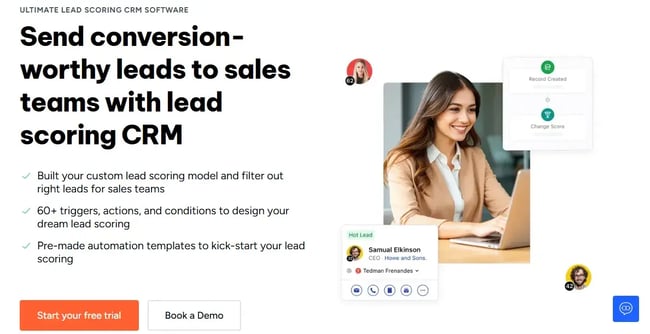
Salesmate CRM includes a lead scoring module that evaluates leads based on behavior, engagement, and demographic or firmographic criteria. The scoring system integrates directly with Salesmate’s pipeline and task management features, enabling teams to focus on high-priority prospects while automatically triggering follow-ups and reminders.
Core Features
- Trigger-based scoring: Points are assigned based on 60+ triggers, conditions, and actions, including email engagement, calls, meeting activity, and other behaviors.
- Seamless CRM integration: Salesmate integrates lead scoring with its CRM, providing a comprehensive, unified lead management solution.
- Additional features: The software also offers lead tracking, web forms, and integration with marketing automation software, making it a versatile solution for effective lead management.
Free trial: Yes
Pricing: The Basic Plan is priced at $23 per user/month, the Pro Plan at $39 per user/month, and the Business Plan at $63 per user/month
What we like: Salesmate offers a solid balance of CRM functionality and lead scoring at a reasonable price. It’s accessible for smaller teams that want to get started quickly, and it connects scoring directly to actionable sales workflows without requiring separate systems. One drawback is that some users say support isn’t as responsive as they’d like.
3. ActiveCampaign Lead Scoring Software
G2 rating: 4.5/5
Best for: Businesses looking for lead scoring tied to email and WhatsApp marketing
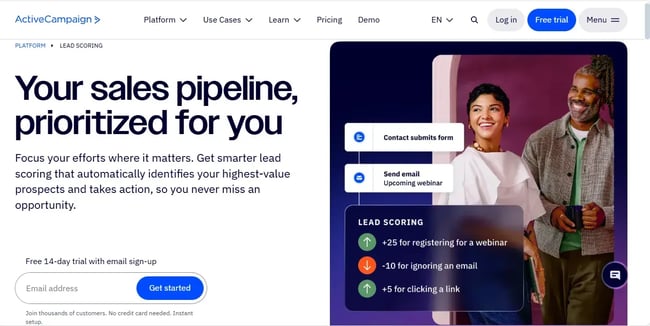
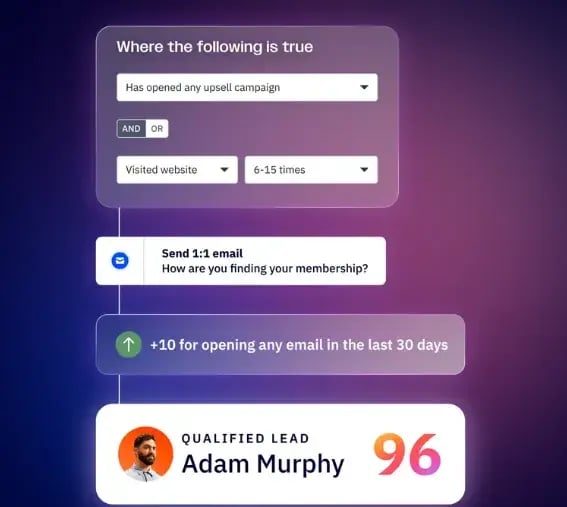
ActiveCampaign’s lead scoring enables teams to assign scores to leads based on engagement behaviors such as email opens, clicks, website visits, and form submissions, as well as custom rules defined by user properties. The platform integrates scoring directly with ActiveCampaign’s email and WhatsApp automation workflows, making it easy to trigger nurturing sequences, sales alerts, or segmentation based on lead scores. While primarily rules-based, ActiveCampaign’s scoring is flexible enough for teams to model multi-channel behaviors and assign dynamic thresholds for follow-ups.
Core Features
- Behavioral scoring: The software assigns points based on actions like email opens, clicks, website visits, and form submissions.
- Custom rules: It is possible to define separate scoring rules for multiple lines of the same business
- Automation triggers: ActiveCampaign allows automatic routing of leads, triggering emails, or adding leads to lists when scores reach defined thresholds.
- Multi-channel integration: The software connects with websites, CRM systems, and third-party tools to capture engagement signals.
Free trial: Yes
Pricing: Lead scoring functions are available as add-ons, starting with the Plus version at $49/user/month for the Email version. The exact charges vary based on the number of users and whether you opt for Email, WhatsApp, or both. More details on pricing are available here.
What we like: ActiveCampaign combines lead scoring with marketing automation in one platform at a price point that may appeal to teams just getting started. It can be a good fit for smaller teams looking to begin without a complex CRM setup. One caveat is that reviews suggest costs can rise significantly as the contact list grows, so buyers should weigh long-term cost and not just the entry price.
4. Zapier
G2 rating: 4.5/5
Best for: Teams seeking highly flexible, cross-platform lead scoring automation without adding a dedicated scoring tool
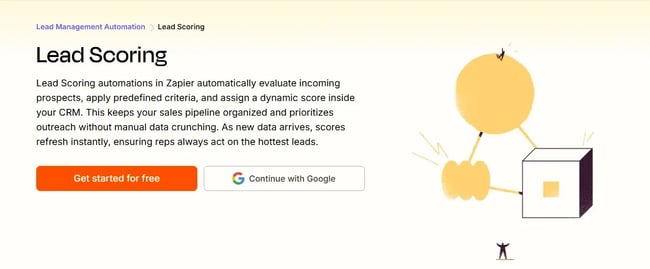
Zapier allows teams to build automated workflows (Zaps) that can assign or update lead scores across multiple platforms. While it is not a traditional lead scoring system, it enables dynamic, rules-based scoring by combining triggers from CRMs, forms, marketing tools, and spreadsheets.
Core Features
- Custom scoring workflows: Allows building scoring logic using triggers and actions across apps.
- Automated updates: Scores adjust automatically in response to defined events, eliminating manual entry.
- Flexible outputs: Supports using scoring to trigger notifications, list additions, or other workflows.
- Multi-app integration: Connects 3,000+ apps, including CRMs, email platforms, and analytics tools.
Free trial: Yes
Pricing: Free tier is available; Paid plans offer more features, higher task limits, and support for a larger number of users. They start at $19.99/month for the Professional Plan and $69/month for the Team Plan. Enterprise Pricing is available on request.
What we like: Many users recognize Zapier for its simplicity and ease of use. It supports modeling a wide range of scoring logic without code, which makes it a strong fit for organizations with fragmented toolsets that still want automated lead prioritization. One limitation is that its native lead scoring features are more limited than those of the other options, and costs can add up with multiple integrations.
5. Pipedrive Score CRM
G2 rating: 4.3/5
Best for: Small to mid-sized sales teams that want built-in lead scoring inside a CRM they already use
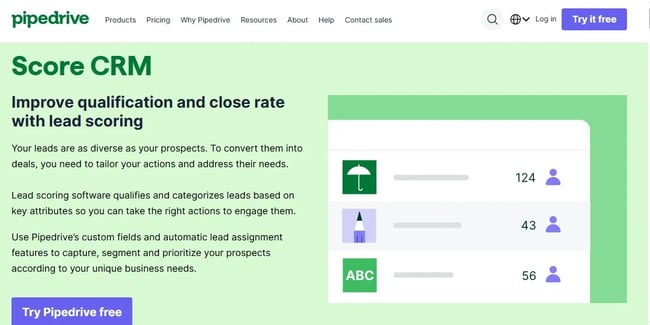
Pipedrive Score CRM is a sales-focused lead scoring feature built into the broader Pipedrive CRM platform. It helps teams qualify and prioritize prospects based on custom criteria. The tool enriches lead profiles with web-sourced contact data and automates administrative tasks, such as email triggers, deal updates, and notifications, to reduce busywork. Its intuitive pipeline view gives sales teams visibility into which leads are closer to conversion so they can take action at the right time rather than chasing every new contact indiscriminately.
Core Features
- Basic lead scoring: Allows prioritizing leads using custom rules and engagement signals
- Built-in CRM scoring: Scores live directly inside the Pipedrive CRM and deal pipeline
- Contact data enrichment: Auto-pulls limited web-based contact information
- Activity-based triggers: Updates deals or notifies reps based on lead actions
- Visual pipeline view: Displays prioritized leads across stages in a simple sales pipeline
Free trial: Yes
Pricing: While basic plans start at $14/user/month, lead scoring features are available starting with the Premium tier, priced at $49/user/month, and the Ultimate tier, priced at $69/user/month
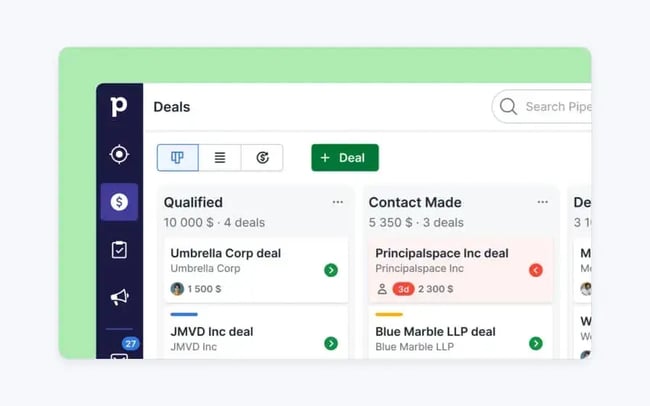
What we like: Pipedrive’s strength lies in its simplicity. With lead scoring built into the CRM, teams don’t need to jump between apps to understand lead quality. The visual pipeline makes prioritization especially clear. One drawback, based on reviews, is integration issues and limited customization options.
Frequently Asked Questions About Lead Scoring Automation Tools
When should you switch from rules-based scoring to predictive?
Consider moving from rules-based to predictive lead scoring when your lead volume and historical outcome data are large enough that simple point systems no longer capture real conversion patterns.
Rules-based scoring works well when users understand their ideal customer and have modest volumes. However, given that it relies on human assumptions, it can quickly become outdated in complex funnels. Predictive models, in contrast, analyze historical won-vs.-lost outcomes and multi-source signals to uncover what actually correlates with conversions, often delivering higher accuracy and better prioritization at scale.
How often should you retrain predictive lead scoring models?
Regularly retraining predictive models is a best practice to stay aligned with evolving buyer behavior and market conditions. Best practice is to retrain at least quarterly. More frequent retraining (monthly) is even better for fast-changing industries or when model performance degrades. To determine when retraining should occur outside preset schedules, you can monitor and compare predicted conversion likelihoods with actual outcomes to gauge whether intervention is needed.
What data sources should be included or excluded in your scoring engine?
Effective scoring models must include behavioral (web visits, email engagement), demographic (job title, role), firmographic (company size, industry), and historical CRM outcome data to capture both who the lead is and how they’ve engaged.
Using external enrichment sources, such as third-party intent data or technographic signals, can improve predictive accuracy only when the data is reliable, permissioned, and consistently tied to real buying behavior. Without certainty about data quality, exclude external data, as it can add noise rather than signal, reducing model accuracy.
How do you keep AI lead scoring explainable for sales and leadership?
AI lead scoring remains explainable when it ties scores to observable, business-relevant signals rather than black-box outputs.
To ensure it’s explainable to sales teams, examine the top contributing factors behind each score, for example, recent pricing-page visits, repeat product demos, or a close match to historical closed-won accounts. That clarifies why someone may have prioritized a certain lead.
At the leadership level, explainability comes from ongoing validation and reporting, rather than from a one-time model setup. Therefore, teams must routinely compare predictive scores against actual conversion outcomes, document which signals consistently drive revenue, and review scoring logic as go-to-market strategies evolve. Remember: When scoring criteria, performance metrics, and business goals stay aligned, AI recommendations become easier to trust and to act on.
From Guesswork to Intelligent Lead Scoring
Lead scoring automation has evolved from simple point-based rules to intelligent systems that combine behavioral data, predictive analytics, and real-time workflows to help revenue teams focus on what truly drives growth. Implementing the right B2B lead scoring tools eliminates manual qualification, reduces sales–marketing friction, and helps teams act on high-intent leads at the right moment.
The biggest gains, however, don’t come from selecting a particular tool. They come from committing to a scoring system that reflects real business priorities and refining it consistently as markets, buyers, and go-to-market strategies evolve. The best tools support that process by offering flexible scoring models, unified data, and tight integration with sales execution workflows.
HubSpot’s Lead Scoring tools deliver both rules-based and predictive scoring within a unified CRM ecosystem. By embedding scoring directly into workflows, reporting, and lifecycle automation, HubSpot ensures insights translate into timely action — and scales as organizational needs grow.